Group finance director's review

We have navigated the COVID-19 storm in 2020 and we believe that we are well positioned for the recovery in 2021, which includes our two acquisitions, Equipment Mongolia and Ingrain

FINANCIAL PERFORMANCE FOR THE YEAR ENDED 30 SEPTEMBER 2020
 |
Group revenue for the period decreased by 17% to R49.7 billion (2019: R60.2 billion). Equipment southern Africa's (snA) revenue declined by 14% against the prior year but was strong against our initial reforecast resulting largely from comparatively good mining machine sales and resilient aftermarket activity levels. Despite the COVID-19 pandemic and geopolitical challenges Equipment Eurasia's revenue increased by 22% benefiting from strong levels of mining activity, particularly in the gold sector. The Automotive division's revenue, excluding NMI-DSM now equity accounted, was down 15% with declines across all business units as COVID-19 and economic pressures impacted discretionary spending coupled with lower fleet utilisation in the Car Rental business. Strong used vehicle sales volumes post lockdown trade restrictions was achieved and margins in this segment are being maintained. Cash generation was supported by the disposal of properties to Khula Sizwe as well as fleet disposals in the Rental and Fleet businesses. In Logistics, revenue declined by 25% against the prior year on the back of the non-renewal of contracts and the contraction of the Transport and Supply Chain markets resulting from weaker demand for goods and services. The weakening South African rand (ZAR) resulted in an increase in revenue of R1.3 billion (2.8%) with the bulk of the increase in the Equipment businesses.

IFRS 16: Leases was adopted for the first time this current financial year and the modified retrospective approach was applied. The comparatives were therefore not restated. The impact of IFRS 16 on the Group's operating profit was an uplift of R147 million because we no longer record operating lease charges, but recognise interest charged and amortisation.
The EBITDA of R4.8 billion was 25% down (2019: R6.5 billion) with the impact of IFRS 16: Leases for the 2020 financial year, being a favourable R549 million in leasing charges no longer included in EBITDA. Depreciation and amortisation were up as a result of first-time implementation of IFRS 16 (R403 million depreciation charge).
 The operating profit for the Group of R1.8 billion was 54% down (2019: R3.9 billion), negatively impacted by lower revenues and higher operating costs. The Equipment snA operating profit was down 35% impacted by lower service labour recoveries, Khula Sizwe charges and once off retrenchment costs while gross margin remained in line with the prior year boosted by a stronger aftersales contribution. In USD terms Equipment Eurasia's operating profit improved by 1.8% with continued cost containment and mix driving the sustained margin, showing resilience. Automotive's operating profit was down by 83%, impacted by losses incurred as a result of trading and travel restrictions as well as once off operating costs. Logistics operating profit reduced to a loss of R153 million against a R38 million profit in the prior year. Cost containment through staff reductions, footprint rationalisation and fit for purpose operating models were key focus areas during the year with benefits expected to be realised in 2021. Corporate cost containment measures, driven largely by a headcount reduction and the reduction of consulting costs to key projects, were implemented to further curb costs. The Khula Sizwe operating profit excluding an R82 million B-BBEE charge was R168 million earned from the 57 properties purchased to date as part of the B-BBEE deal and rentals earned from divisions.
Khula Sizwe costsIFRS 2 Charges R223m Implementation costs R13mUp from (2019: R73m) |
The South African rand (ZAR) exchange movements have increased operating profit by 5.4% equalling R98 million from Equipment Eurasia. The Group operating margin of 4.1% is down on the prior year (2019: 6.6%) and net profit after tax has decreased by 211% to a R2.5 billion loss against the prior year of R2.2 billion.
Losses from fair value adjustments on financial instruments totalled R340 million driven by negative currency movements and forward exchange contract cost impacting Equipment snA, of which R96 million related to RSA and R114 million related to the rest of Africa, which were further impacted by R187 million loss in the UK from the derecognition of the USD denominated cash deposits, realised in the income statement in September.
Losses from non-operating and capital items of R1.9 billion largely relate to the impairments taken in March against BZAMM, Car Rental and our investment in BHBW. To note the NMI-DSM investment impairment at March of R124 million was reversed in full, however further impairments were taken in September relating to properties of R167 million and right of use assets of R40 million.
With the exclusion of IFRS 16 we saw a reduction in the net finance costs in 2020 on the back of reduced interest rates in South Africa. Net finance costs of R1.1 billion (2019: R0.9 billion) include IFRS 16 charges of R285 million together with Khula Sizwe external net finance charges of R82 million. Lower marginal rates in South Africa have provided some relief despite higher borrowings.
The effective tax rate before exceptional items and prior year adjustments was 251% (2019: 28.4%). The increase in the current year's tax rate is largely due to local currency profits in the offshore entities, Khula Sizwe capital gains taxes and IAS12.41 adjustments arising from the negative in country currency movements against the USD.
Joint ventures and associates generated losses of R48 million compared to the prior year's profits of R231 million. The BHBW joint venture contributed a loss of R58 million (2019: R24 million loss) and remains under pressure. Bartrac, our joint venture in the Katanga province of the DRC generated losses of R41 million (2019: R268 million profit). The DRC has seen some green shoots in activity levels over the last two months of the financial year against the losses of the first three quarters of the year. NMI-DSM contributed an impressive result of R52 million (noting that in 2019 NMI-DSM was a subsidiary for 11 months and generated profit after tax and 1 month associate income at September 2019 of R40 million).
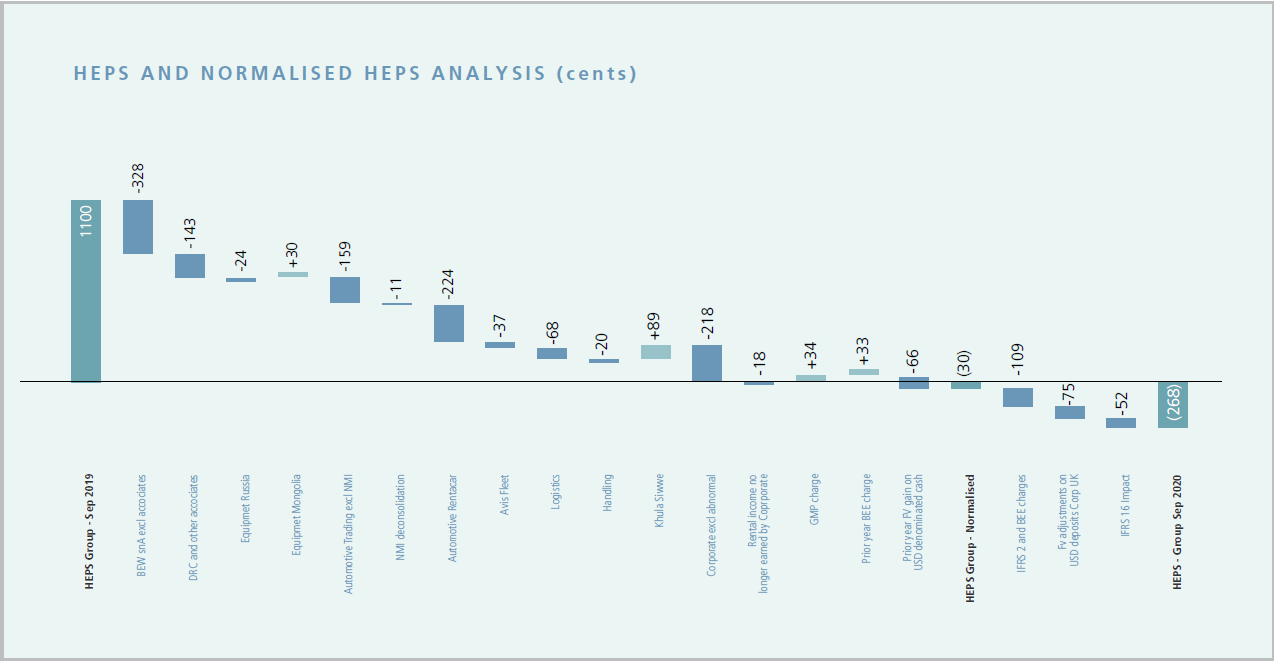
Normalised HEPS*, excluding the impact of IFRS 16, B-BBEE IFRS2 charges and the fair value on the USD deposits in the UK was a 30 cents loss and well down on prior year of 1 167 cents. HEPS loss of 268 cents was impacted by all operations performing at levels well below the prior period.
Net profit after tax impact of IFRS 16:
R105mEffective 1 October 2019 |
RATIOS AND ROIC
Performance against metrics has generally been below target and prior year on the back of depressed trading results. Most of our businesses generated ROIC below the hurdle rates (and consequently generating negative economic profit) with the exception of Equipment Russia that has performed particularly well under the circumstances achieving a ROIC of 14.2% (2019: 17.3%).
CASH FLOWS
Net cash generated from operating activities to 30 September 2020 of R2.4 billion was marginally down on prior year (2019: R2.6 billion). Despite the decreased activity levels across the Group the working capital levels were well maintained largely due to a decrease in receivables as a result of accelerated collection and a decrease in business activity. Investments in leasing and the rental fleet have been well contained in the year resulting from lower demand in these businesses and the sale of excess vehicle capacity within the Car Rental business.
Net cash used in investment activities of R3.0 billion includes the Mongolia acquisition of R2.6 billion which when excluded was favourable compared to the prior period on the back of reduced capex investments as the Group focuses on cash containment and inflows from disposals in the year.
The free cash flow for the period was positive at R575 million, however, excluding the Equipment Mongolia acquisition of R2.6 billion, this is comparable to 2019's R3.1 billion.
FINANCIAL POSITION, GEARING AND LIQUIDITY
|
The Group's balance sheet as at 30 September 2020 remained strong considering the challenging environment. A robust and solid liquidity position with cash balance of R6.7 billion was maintained with the net debt position including the Equipment Mongolia acquisition, increasing to R2.6 billion from R1.1 billion in 2019. The headroom on committed facilities remained substantial at R10.1 billion. These facilities exclude the ring-fenced R5.4 billion of committed funding for the Ingrain acquisition and therefore the total headroom as at 30 September amounted to R15.6 billion. The funding capacity of the Group remains healthy as management continues to focus on actively reviewing and monitoring all facilities on an ongoing basis and remain confident of the good liquidity position.
At the end of 30 September 2020, the Group's gearing levels increased and our financial position was well within our covenants.It is important to note that, in April 2020, the EBITDA to interest covenant was renegotiated from 3.5 times to 2.5 times based on an unpredictable future that was forecasted at the time. The Group not only met the renegotiated covenant but also remaining well within our old covenant targets even post acquisition of Equipment Mongolia. Management interventions during the lockdown period have sown positive results in managing our assets and liabilities.
| Debt covenants | September 2020 |
September 2019 |
| EBITDA: interest cover >2.5 times | 4.7 times | 5.7 times |
|---|---|---|
| Net debt:EBITDA <3.0 times | 0.6 times | 0.2 times |
Even after taking into account the acquisitions being progressed, we retain significant headroom within our covenants, with Net Debt to EBITDA remaining below 1.0 times, the target being below 3.0 times.
NORMALISED RETURNS
ROIC, EP and FCF are key performance measures for the Group. Performance during the period was impacted by tough trading conditions.
| Debt covenants | September 2020 |
September 2019 |
| ROIC (%)* | 1.0 | 11.9 |
|---|---|---|
| EP (R million)* | (3 037) | (323) |
| Free cash flows (R million)* | 575 | 3 064 |
| Return on ordinary shareholders funds (%) |
(1.5) | 10.6 |
* Refer to definitions in the Group annual financial statements
EVENTS AFTER BALANCE SHEET
The acquisition of Ingrain was concluded after the financial year-end and is now a subsidiary of Barloworld Limited effective on 31 October 2020.
OUTLOOK
Notwithstanding the tough Group results achieved in the midst of unprecedented challenges, we expect to begin realising significant cost efficiencies and operational synergies in the short term from the Group-wide implemented austerity measures. In addition, the implementation of the Barloworld Business System across the Group, new ways of working, founded on lean principles and continuous improvement, position us well to continue to show resilience during volatile macroeconomic dynamics in the local and global economies. We are already seeing the benefits of the BBS being realised in our Equipment southern Africa business through increased cash flows and reductions in invested capital, and this trend is expected to continue. Generating free cash flows remains and ensuring that the Group's assets generate a return on invested capital above our stated weighted average cost of capital target of 13% remains a group imperative. Our strong cash position, which will be bolstered by the capital released from the Khula Sizwe transaction, stands us in good stead in the short to medium term.
The coronavirus outbreak is still evolving, and its effects remain unknown with the current uncertainties and market volatility that it brings. We have navigated the COVID-19 storm in 2020 and we believe that we are well positioned for the recovery in 2021, which includes our two acquisitions, Equipment Mongolia and Ingrain.
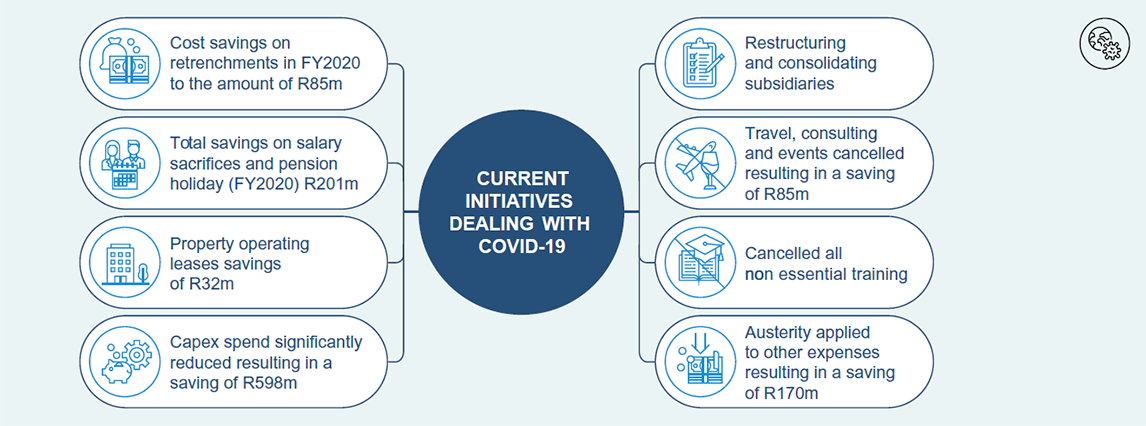
MANAGING THE IMPACT: COST CONTAINMENT MEASURES
 |
APPRECIATION
I would like to thank my board colleagues and the Group executive committee for their support and guidance during the current period.
I would also like to extend my appreciation to the finance team's commitment to ensuring the highest standards of integrity and financial discipline.

NOPASIKA LILA
Group finance director
30 November 2020