Remuneration summary report
This report is part of the remuneration report and will be put to a non-binding advisory vote by shareholders at the upcoming AGM. It summarises the company’s remuneration policy for non-executive directors, executive directors and prescribed officers. The information provided in this report has been approved by the board on the recommendation of the remuneration committee. The full remuneration report is available on the company’s website, www.barloworld.com.
Role of remuneration committee
The remuneration committee operates under terms of reference, a copy of which can be found on our website www.barloworld.com. The remuneration committee chairman reports formally to the board on the proceedings of the remuneration committee after each meeting and, in line with King III, will attend the annual general meeting of Barloworld to respond to any questions from shareholders regarding the remuneration committee’s areas of responsibility.
Members of remuneration committee
The remuneration committee is constituted as follows:
| – |
SB Pfeiffer (chairman) (independent non-executive) |
| – |
DB Ntsebeza (independent non-executive and chairman of the company) |
| – |
AGK Hamilton (independent non-executive) |
| – |
SS Ntsaluba (independent non-executive) |
| – |
B Ngonyama (independent non-executive) |
The CE attends remuneration committee meetings by invitation, but does not participate in the voting process, and is not present when his own remuneration is discussed or considered. PricewaterhouseCoopers (PwC), the company’s independent advisers, attend the meetings in an advisory capacity. The company secretary, Ms L Manaka, acts as secretary to the remuneration committee.
Advisers
During the 2014 financial year, the remuneration committee received advice and guidance from the following independent advisers:
| – |
PwC – standing adviser to the remuneration committee on all executive and non-executive remuneration matters including guaranteed pay, short-term incentives, long-term incentives,non-executive directors’ fees and general corporate governance standards |
| – |
PE Corporate Services – executive salary benchmarking and job grading |
Linking remuneration to strategic objectives
Our business strategy concentrates on six strategic focus areas, which are supported by performance indicators.
How we reward our staff, in particular our executive staff and prescribed officers, is in line with our dedication to achieving our strategic objectives. Below, we set out our six strategic focus areas, and how our remuneration policy and practices link in to these focus areas.
| Strategic focus area |
|
Strategic objectives |
|
Link to remuneration policies and practices |
 |
|
|
|
|
 |
|
Achieve targeted
compound growth in
total shareholder returns
over five years to
September 2015. |
|
| – |
Executive remuneration is heavily weighted towards variable
remuneration, to ensure the alignment of executive interests
with those of our shareholders. As part of the variable
remuneration offered to our executives, long-term incentive
(LTI) awards under the Forfeitable Share Plan (FSP) and Share
Appreciation Right Scheme (SAR) are made. The vesting of
these awards is dependent on the achievement of stretching
performance conditions |
|
|
|
|
|
|
 |
|
Build an organisation
that adds value to
employees as our
success is based on
inspired, aligned,
empowered, results-driven,
globally
competitive, passionate
people who create value
through strategic
innovation and
continuous
improvement. |
|
| – |
Barloworld aims to provide a level of remuneration which
attracts, retains and motivates staff, in particular executives, of
the highest calibre |
| – |
Barloworld’s overall remuneration philosophy is to ensure that
executive directors and the senior executive team are fairly
rewarded for their individual contribution to the company’s
operating and financial performance in line with its corporate
objectives and strategy, and in line with this, we are
committed to paying remuneration that is competitive relative
to the target labour market in each country based on industry
and market benchmarks reviewed by the company on an
annual basis |
|
|
|
|
|
|
 |
|
Drive market leadership
through competitive
differentiation by
accelerating the
evolution of our business
model from pure
distribution to the
provision of flexible,
value-adding, integrated
customer solutions. |
|
| – |
The short-term incentive (STI) rewards and motivates the
achievement of agreed group, divisional and individual
performance objectives. |
| – |
In respect of personal scorecard objectives for the STI, key
performance indicators (KPIs) such as the following would be
included to drive performance in line with this strategic
objective:
| – |
Market share targets |
| – |
Customer loyalty and growth |
| – |
Aftermarket growth targets |
|
|
|
|
|
|
|
|
 |
|
Develop products and
services to capitalise on
emerging sustainable
business opportunities,
realise cost savings
through energy
efficiency and other
sustainable business
practices, and enhance
Barloworld’s reputation
by leading in sustainable
development. |
|
| – |
The STI rewards and motivates achievement of agreed group,
divisional and individual performance objectives, and sustainable
development KPIs are included in personal scorecard objectives |
|
|
|
|
|
|
 |
|
Enhance
competitiveness,
credibility, legitimacy and
reputation in the eyes of
all stakeholders by
leading in broad-based
empowerment and
transformation. |
|
| – |
In respect of personal scorecard objectives for the STI, key
performance indicators such as the following would be
included:
| – |
B-BBEE rating level targets |
| – |
Workforce diversity targets |
|
| – |
Further, careful consideration is also given to internal equity
within the group and to align the remuneration paid with
shareholder interest and best practice |
|
|
|
|
|
|
 |
|
Achieve top-quartile
financial returns as
measured against peer
groups in each of our
chosen business
segments. |
|
| – |
For the STI, a combination of the following metrics are used to
ensure that financial returns remain a top priority for our
executives:
| – |
Operating profit |
| – |
Cash flow |
| – |
Return on equity (ROE) |
| – |
Headline earnings per share (HEPS) |
|
| – |
For the LTI, returns on net operating assets is a performance
condition for the FSP |
| – |
Additionally, HEPS has been used, and continues to be used as
a performance condition for both the FSP and the SAR |
|
Barloworld has adopted a holistic approach to its remuneration philosophy for senior executives and general staff and has implemented a balanced design which consists of the following monetary and non-monetary components:

Divisional incentive plans are aligned such that divisional executives and management are incentivised on similar financial targets to executive directors, with total incentives benchmarked against market comparisons for equivalent levels of management.
Overview of remuneration
Role of benchmarking and salary adjustments
Barloworld operates the Towers Watson global grading methodology and structure. This assesses an executive’s remuneration against an independently determined grade which is based on a number of factors including the “size” of the job (as measured by revenue and number of employees) as well as its “complexity” (incorporating aspects such as whether it is a domestic, international or global business).
Remuneration of divisional executives and senior management below executive director level is also benchmarked to independent market information based on the same grading system.
The remuneration committee approves salary increases and incentives for executive directors and prescribed officers on an individual basis. The salary adjustments for other employees are cascaded downwards throughout the group to the appropriate heads of divisions starting with the divisional CEO that approves the salary increases and incentives for executives on the divisional management boards.
Package design
Executive remuneration is heavily weighted toward variable remuneration as is illustrated below.
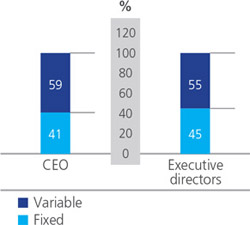
Elements of remuneration
The table below summarises the composition of the total remuneration package for executive directors and prescribed officers during the 2014 financial year. No material changes to the remuneration philosophy and practices in respect of executive directors and prescribed officers were made during the year, and none are envisaged for the 2015 financial year.
| |
Element |
|
Objective |
|
Policy |
|
Changes
for 2015 |
|
|
|
|
|
|
|
|
| |
|
|
FIXED |
|
|
|
|
|
|
|
|
|
|
| |
Base salary |
|
Reflects scope and nature
of role, performance and
experience. |
|
In most cases, base salary is benchmarked around the
median of the market. Variations around the median may
be influenced by factors such as the nature of the
assignment, level of experience of the executive, changes
in responsibilities, performance track record, and strategic
importance of the role.
The company uses independent consultants, namely PE
Corporate Services, to conduct the annual benchmarking
exercise, and the results are discussed with PwC, as
standing advisers to the remuneration committee.
The level of base pay paid to executives is considered to be
competitive in the appropriate labour market where the
executive operates, as a result of the independent
benchmarking performed, as well as the selection of
comparator companies used. |
|
None |
|
|
|
|
|
|
|
|
| |
Benefits |
|
Provides employees with
contractually agreed basic
benefits such as medical
aid, retirement funding
and a company car or car
allowance as per the
human resource policy. |
|
The percentage company contribution to benefits varies by
country. In South Africa, a 14% company contribution to
retirement funds applies. |
|
None |
|
|
|
|
|
|
|
|
| |
Long-term
incentive |
|
Creates loyalty and
ownership among
employees and acts as a
retention mechanism.
Also aligns with
shareholder interests and
long-term value creation. |
|
The company operates the following long-term incentive
plans:
| – |
Forfeitable Share Plan (FSP) |
| – |
Share Appreciation Right (SAR) Scheme |
It is essential for the group to retain skills over the longer
term and to motivate and incentivise executive directors
and other senior employees to drive sustainable value
creation over multiple reporting periods and to be
shareholders of the company. This is achieved through
long-term incentive plans and annual awards using the FSP
and SAR Scheme. In line with these objectives, in the case
of the executive directors and prescribed officers, the FSP is
25% retention driven and 75% performance driven, and
the SAR Scheme is 100% performance driven.
An aggregate limit of 22 744 049 (twenty two million,
seven hundred and forty four thousand and forty nine)
shares equating to approximately 10% (ten percent) of the
current issued share capital of the company applies to the
all the share plans (including the old share option scheme).
The maximum number of unvested FSP awards which may
be made to any one participant is 0.25% of the issued
ordinary share capital and the maximum number of
unvested SARs granted to any one participant may not
exceed 1% of the issued ordinary share capital of the
company.
On an annual basis, the remuneration committee
determines the quantum of awards to be made, the
performance targets and mix of instruments to be granted
to eligible employees.
Forfeitable Share Plan (FSP)
Awards are structured as forfeitable share awards. This
means that participants receive shares (including dividend
and voting rights) on the date of award but those shares
are subject to restrictions and a risk of forfeiture during a
three-year vesting period. In addition, in respect of
executive directors, the vesting of the majority of the
forfeitable share award is subject to the satisfaction of
performance targets. To the extent that the performance
targets are not achieved, those shares subject to the targets
will be forfeited and there will be no re-testing of the
performance targets. The performance targets are
measured over a three-year period.
Share Appreciation Rights (SARs)
The SAR Scheme was developed with the object and
purpose of providing employees with an opportunity to
benefit from growth in the value of the ordinary shares of
Barloworld. The SARs are subject to a three, four and
five-year vesting period. All SARs will lapse if not exercised
within six years from date of grant. The first four awards
(2006 to 2009) were cash-settled. From 2011, awards are
equity-settled. From 2007, the entire SAR award was
subject to a performance target. |
|
None |
Performance targets
The financial metrics for short and long-term incentives are set by the remuneration committee on an annual basis, and are carefully selected based on key business drivers over the short and long term.
The metrics which have been used in the past, and are envisaged to be used in future, are as follows:
Short-term incentive
Financial metrics
The financial metrics are set by the remuneration committee on an annual basis. These metrics are elected based on key business drivers over the short term. A combination of the following metrics has been used in the past and is envisaged to be used in future:
| – |
Operating profit |
| – |
Cash flow |
| – |
Return on equity (ROE) |
| – |
Headline earnings per share (HEPS) |
Group targets apply in the case of the CE and financial director. Group targets are considered appropriate for these individuals due to the strategic nature of these roles, and their responsibilities for the performance of the group as a whole.
Divisional targets apply for the rest of the executive directors and prescribed officers, with the exception of HEPS, which is measured for all on a group basis in recognition of the collective responsibility they bear for the performance of the group as a whole.
The targets set take into account the current trading conditions and challenges being faced by the company or relevant division and incorporate a meaningful level of stretch to motivate and retain senior employees. The threshold targets are set at a level which represents the minimum level of acceptable performance for the business.
Personal objectives
In respect of personal scorecard objectives, these would typically include aspects such as:
| – |
Safety performance |
| – |
Market share targets |
| – |
People development and training |
| – |
Sustainable development key performance indicators |
| – |
Empowerment and transformation objectives |
| – |
Customer loyalty and growth |
| – |
Relationships with principals |
| – |
Aftermarket growth targets |
| – |
Acquisitions and disposals |
| – |
Special projects |
The personal objectives component of the scheme is the same for the CE, executive directors and prescribed officers. The percentage of annual basic salary which will be paid as the portion of the STI which is attributable to personal performance is represented below.
Earning levels
The percentage of basic salary eligible to be paid as a bonus based on relative achievement against targets (threshold, target and stretch) is:
CE
| Performance metric |
Threshold
% |
|
Target
% |
|
Stretch
% |
|
| Bonus based on financial targets |
25 |
|
75 |
|
120 |
|
| Bonus based on personal scorecard objectives |
15 |
|
22.5 |
|
30 |
|
| |
40 |
|
97.5 |
|
150 |
|
Executive directors and prescribed officers
| Performance metric |
Threshold
% |
|
Target
% |
|
Stretch
% |
|
| Bonus based on financial targets |
25 |
|
60 |
|
95 |
|
| Bonus based on personal scorecard objectives |
15 |
|
22.5 |
|
30 |
|
| Total bonus |
40 |
|
82.5 |
|
125 |
|
Long-term incentives
Details surrounding the performance conditions for the LTIs are set out below:
| |
|
SAR |
|
FSP |
| Performance condition(s)
and weighting |
|
Headline earnings per share (HEPS)
SARs are also subject to the inherent
performance condition of share price
appreciation above the strike price (being the
current share price at the date of issue) |
|
The following performance targets have been
used and are envisaged to be used in future:
| – |
Relative total shareholder return (TSR) |
| – |
HEPS |
| – |
Return on net operating assets (RONOA) |
|
| Vesting of awards at
threshold performance |
|
25% |
|
30% |
| Vesting of awards at
on-target performance |
|
100% |
|
100% |
| Performance period |
|
The performance conditions are measured over a three-year period, commensurately with the financial years of the company. |
Executive contracts
The main terms of the service contracts applicable to executive directors are summarised below:
| PROVISION |
|
POLICY |
| Contract term |
|
Indefinite (or until normal retirement age in the relevant jurisdiction) subject to specified notice periods by the executive and the company |
| Notice period |
|
| – |
Nine months for the group CE |
| – |
Six months for other executive directors |
|
| Termination of employment and change of control payments and/or automatic vesting of long-term incentives |
|
Change of control clauses are covered by FSP and SAR rules and allow for proportionate vesting of awards. Change of control clauses in employment contracts provide for redundancy terms, based on established guidelines, in the event of termination of employment within six months of change of control |
| Restraint of trade |
|
Not applicable |
| Other benefits |
|
Certain executives may be employed in terms of expatriate contracts which include typical expatriate benefits in addition to the standard benefits |
The appointment of non-executive directors (NEDs) is governed by a letter of appointment that sets out, among other things, the term of appointment, duties and responsibilities, fees and other payments, and termination of services.
NEDs receive a standard fee for their services on the board and board committees. The remuneration committee reviews the level of fees and makes recommendations to the board for consideration. A benchmarking exercise was conducted in November 2014 by PwC, the company’s independent remuneration adviser. In terms of Barloworld’s Memorandum of Incorporation, fees payable to NEDs must be approved by shareholders in general meeting. The current level of fees payable to non-executive directors was approved by Barloworld’s shareholders at the annual general meeting held on 29 January 2014. Proposed fees for the 2015 financial year are set out in the notice to the annual general meeting.