
Creating value for our communities
 |
Sustainable development |
Strategic intent
To lead in sustainable development through respectable corporate citizenship and by delivering products, services and solutions that generate sustainable outcomes and realise commercial opportunities for revenue enhancement and cost savings.
Value created and material themes
We are committed to “inspiring a world of difference” and supporting organisational resilience in the context of increasing environmental awareness, climate change, rising costs, regulatory requirements, concerns for natural resources, commitment to being a respected corporate citizen.
Sustainability is integrated in our day-to-day operations and in our innovative product and service offerings. This aligns to the group’s shared value philosophy that strives to achieve a balance of environmental stewardship, social responsibility and economic growth. We provide work environments, products, services and solutions that make productive and efficient use of resources as we strive to achieve our vision. We believe this commitment supports the enduring success of our customers, shareholders, people and other stakeholders.
The focus of this section is on our value chain, environmental stewardship and our role in communities.
| Value for our environment | SFAs addressing value for our environment | Material themes addressed by our SFAs | |
Conducting business in an environmentally responsible manner
|
|
|
|
| Impact on the capitals |
|
||
| Impact on the environment |
|
||
| Engaging the environment |
|
||
Underscoring our commitment to sustainability our performance against environmental, social and governance (ESG), Barloworld is included in the following indices during the financial period:
FTSE/JSE Responsible Investment Top 30 Index.
One of 12 South African companies on the Dow Jones Sustainability Emerging Markets Index.
Responsible value chain
Given our core values, it is important to align ourselves with a robust supply chain, responsible leading principals and OEMs.
Underpinning our relationships throughout our supply chain are values of mutual respect, trust, support and benefit, guided by our governance and ethical frameworks. The group has developed a set of conduct criteria and standards for suppliers which form part of our supplier due diligence initiative aimed at assessing and limiting any potential risks emanating through our supply chain. Our commitment is also reflected in our Worldwide Code of Conduct.
Integral to our value chain is our commitment to being a leader in sustainable development and identifying competitive advantages through solutions that help customers achieve their sustainability objectives, facilitate a transition to lower carbon economies and expand into related opportunities.
A key socio-economic driver within the South African context is integrating previously disadvantaged groups into the economy. Aside from our OEMs, we support and empower a range of small and medium-sized suppliers, contractors and enterprises in our supply chain, through our South African-oriented enterprise development initiatives and preferential procurement programme. We are committed to the localisation and empowerment of our supply chain where practicable, and have completed a number of supplier development interventions and engagements in South Africa over the past year.
To extend our supplier diversity and empowerment objectives, the group collaborated with the South African Department of Trade and Industry (dti) in 2016 to establish a supplier incubation hub that will further develop small and medium-sized suppliers.
Responsible principals
Barloworld represents leading international OEMs and brands such as Audi, Avis, BMW, Budget, Caterpillar, Ford, General Motors, Hyster, Jaguar Land Rover, Massey Ferguson, Mazda, Mercedes-Benz, Toyota, Volkswagen and others. The group is therefore part of supply chains that reflect international best practice in the manufacture, sale, service, support and disposal of products. These standards are complemented by Barloworld’s own ethics, values and standards. We are committed to working with suppliers to assist our customers to meet their objectives and to enhance their competitive position. We review our principals for sustainability-related risks and a number are included on sustainability-related indices, further supporting their reputation as responsible companies. We are aware of the well-publicised Volkswagen (VW) and Audi emission issue affecting customers internationally. We recognise the associated risks and are engaging with our principal. The VW and Audi vehicles sold in our dealerships meet local emission compliance standards and our operations have consequently not been directly impacted. The uncertainty and anxiety caused to our customers and any other stakeholders is regretful.
Products and services
Innovative solutions offered by Barloworld contribute towards customers achieving their own sustainable development objectives. Divisional offerings enable vehicles, plant and equipment solutions to be sold either new or used, or leased on a short or long-term basis.
Our Power division has also expanded its offerings to include solar photovoltaic (PV) solutions which help the group and our customers meet respective sustainability imperatives. Incorporated within the Equipment division is a significant component rebuild programme, which aligns with our responsible waste management and minimisation objectives. This business model ensures efficiencies and synergies throughout the lifecycle of vehicles, plants and equipment and extends the useful lives of these products.
Barloworld Logistics offers a range of supply-chain optimisation products, including energy-efficient transport solutions that reduce carbon footprints. SmartMatta, an environmental solutions company that offers waste management solutions to support both internal and customers’ responsible waste management objectives, was acquired in 2015.
All businesses are appropriately leveraging technology to optimise their solutions offerings. Online business initiatives and platforms in all business units enhance the coverage, efficiency and effectiveness of our solutions.
Customer health and safety
Critical to all Barloworld products, services and customer solutions, is the health and safety of our customers. In representing leading global brands, our customer solutions are backed by warranties, guarantees and product responsibility, as well as unique design features that target optimum user safety and productivity.
Customer satisfaction
Our ability to identify and understand customers’ requirements, expectations for products, services and service levels, combined with our capability to consistently exceed these have been central to building customer loyalty and expanding our customer base. Extensive customer engagement and monitoring initiatives are in place at all divisions to assess customer perspectives and needs.
Stringent measurement and survey systems, as well as targets and, in some instances, agreed performance measures are among such engagement and monitoring initiatives. Performance against defined objectives is monitored and reviewed to highlight areas for attention, direct operational activities and inform strategy.
Marketing communications
Group standards ensure that all marketing and advertising conforms to applicable laws and standards, including the corporate identities set by principals. These are detailed and comprehensively monitored by Barloworld divisional operations and their principals, who provide prior consent for any local adaptations. We are also guided by standards set by industry bodies.
Reducing our environmental footprint and managing our impact
Barloworld is committed to responsible environmental stewardship and minimising our environmental footprint. These aspects underpin the group’s response to climate change and are incorporated into sustainable development, which is one of the group’s six strategic focus areas, with sustainability identified as one of the group’s five core values in our Worldwide Code of Conduct.
We recognise that some of our activities have certain adverse environmental impacts, such as those associated with the use of fossil fuels, and therefore mitigation measures are integrated into our operational management systems and customer offerings. We mainly represent OEMs and recognise the environmental impact from the manufacture and use of our vehicles, plant and equipment. As a responsible corporate citizen, we engage our suppliers and customers in striving to achieve the highest environmental standards.
Our key areas of monitoring and management are:- Energy consumption
- Greenhouse gas emissions
- Water stewardship
- Waste management
- Spills
Policies
Barloworld’s approach to environmental stewardship is informed by and embodied in a range of group-wide policies, including climate change; energy efficiency; environmental; water use and management; and waste management policies.
Overview of environmental risk management and responses
Environmental risks are identified and assessed through:
- A high level risk assessment (HLRA) which takes place twice a year and considers all risk exposures facing the group. HLRAs are held at both divisional and group levels. Material risks and management responses are disclosed in the group’s reported risk matrix
- Focused risk assessments are conducted annually to identify and assess both risks and opportunities around climate change and water. Material aspects are disclosed in Barloworld’s 2016 CDP Climate Change Disclosure and 2016 CDP Water Disclosure. These risk assessments are aligned to the HLRA approach and the group’s risk management framework.
Key indicators
Data collection is designed to enhance the management and reporting of material environmental indicators that require managerial attention. To enhance the efficiency and credibility of reported sustainability data, three reporting systems were implemented during the financial period.
Energy and emission conversion factors
Marking the start of a new target period, Barloworld has updated all energy and carbon emission equivalent conversion factors in the financial period. These updated factors have been reviewed by the group’s external assurance provider, who also assured the calculations methodology and output.
As a result of the changes, our baseline and overall non-renewable energy (GJ) reduced by 6% and emissions (tCO2e) (scope 1 and 2) reduced by 11% for each of the respective periods.
The new conversion factors and related impacts are available online at www.barloworld.com/sustainability/policies-and-disclosures.
Monitoring and management
Reported environmental data is used in the daily management of the company. A quarterly safety, health and environment (SHE) report reflecting material and relevant group aspects are reported at board level through the risk and sustainability committee.
Three lines of control exist for data collection and reporting processes, namely management review, internal and external audits.
Barloworld group’s internal audit service reviews reporting processes throughout the year and selected material indicators are assured by the group’s external auditors at financial year-end.
To enhance the credibility of environmental disclosures and to align governance processes between financial and non-financial disclosures, material non-financial indicators are tabled at the divisional and group audit committees.
Aspirational group targets are set for the end of our 2020 financial period. While progress against targets may not be linear over the target period, this is monitored and disclosed.
Our performance during the year
Non-renewable energy consumption
In light of increasing energy costs and energy supply challenges, the group has adopted the measure, avoid, reduce, switch and offset (MARSO) approach to meet our energy and emissions efficiency improvement objectives. Some of our operations are entering MARSO’s switch phase and have begun implementing solar PV solutions, which will counter increasing energy costs, reduce reliance on the electricity grid and improve our carbon footprint.
Barloworld recognises the economic importance and environmental relevance of non-renewable energy consumption and strives to improve the group’s efficiency and consumption patterns.

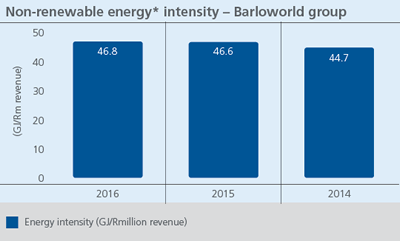
Energy consumption was 7% up from 2015.
 * Excludes energy from rental fleets.
Performance against group aspirational non-renewable energy efficiency target
The group’s aspirational target of a 10% efficiency improvement to be achieved by the end of our 2020 financial period represents a non-renewable energy intensity of 42.0. The current intensity is 46.8.
Renewable energy consumption
Performance against group aspirational renewable energy target
Our aspirational group target is to have 2 000 MWh or more renewable energy consumption by the end of our 2020 financial period. Progressing towards this target, a 300 kW (peak) solar PV application was installed at Equipment’s Isando site towards the end of the period.
This has produced some 90 MWh of renewable energy by the end of the reporting period.
There are a number of such installations anticipated for the upcoming financial period, including a 600 kW (peak) installation at Equipment’s Boksburg campus.
Greenhouse gas emissions
We remain concerned about climate change and the impact of greenhouse gas emissions on global warming. While emission restrictions and proposed carbon taxes pose risks to Barloworld and our value chain, including our customer base, these also present opportunities, such as increased demand for products and solutions with limited or reduced carbon emissions, as well as implementing internal initiatives to further improve energy and emissions efficiency with related cost savings. The group continues to report greenhouse gas emissions in terms of the GHG Protocol Corporate Standard and in units of tCO2e, the universal unit measure adjusted for the global warming potential of the six Kyoto Protocol greenhouse gases. Emissions from customer use of our rental fleets are classified as scope 3 emissions.
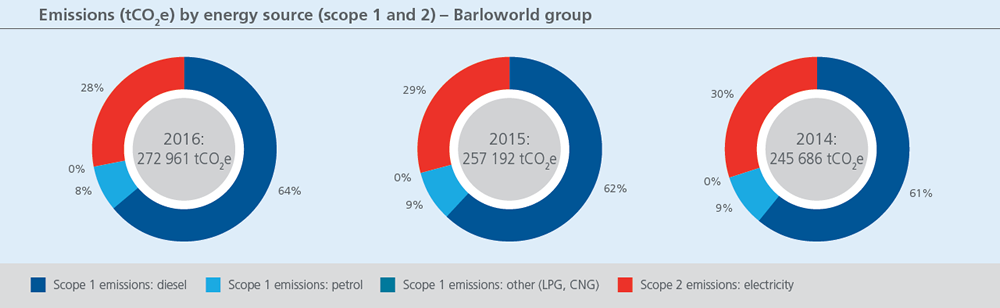

Aligned with the increase in energy consumption, group emissions were 6% up from 2015.
Since our material greenhouse gas emissions are linked to energy consumption (particularly petrol and diesel and, indirectly, electricity (which is principally generated from coal)), many of our energy efficiency initiatives have a secondary benefit of reducing greenhouse gas emissions.
Performance against group aspirational greenhouse
emissions (scope 1 and 2) efficiency target
Our emission patterns follow those of our energy
consumption.
The group’s aspirational target of a 10% efficiency improvement to be achieved by the end of our 2020 financial period, represents an emissions (scope 1 and 2) intensity of 3.7. The current intensity is 4.1.
Scope 3 emissions
Recognising our broader activities and the nature of our products and solutions, we report certain scope 3 emissions. These cover business air travel and emissions from Avis Budget’s South African rental fleet.
Car rental operations in South Africa produced 105 179 tCO2e (2015: 99 162 tCO2e), an increase of 6% from 2015. This figure has been included in our external assurance review for the first time this year. Over 2015, emissions intensity per rental day increased marginally while emissions intensity per kilometre decreased marginally.
We intend to report emissions from other significant rental fleets. These processes are being refined and disclosure will be considered in due course.
Water consumption
Despite being a limited consumer of water, Barloworld recognises how scarce water is and strives to use it efficiently and responsibly. Increased water recycling, rain-water harvesting and efficiency of use are among the water stewardship initiatives we have implemented within the group. Water withdrawal from municipal sources (788 ML) is 6% up on 2015.
Water is predominately used to wash vehicles, plant or equipment and is sourced from municipal and local government supply systems. All withdrawn water is discharged back into municipal and local government systems, after passing through filtration and separation processes.
Overall, 17.2% (2015: 20.2%) of water was recycled in the group, with Automotive recycling 34% and Equipment operations in Iberia recycling 7% of their reported volume of withdrawn water.
No protected areas were affected by water discharges from the group, nor were any water sources affected by our withdrawal of water in the past year.
Performance against group aspirational water efficiency target
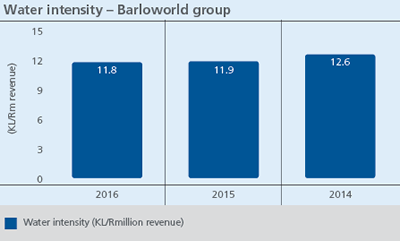
In absolute terms the group’s aspirational target of a 10% efficiency improvement to be achieved by the end of our 2020 financial period, represents an intensity of 10.7. The current intensity is 11.8.

Waste management
Given the nature of our business, the group does not generate significant volumes of waste. Waste generated is monitored by systems that are evolving and improving, and which currently monitor waste type, volume, disposal method and destination.
Paper, tyres and oil filters constitute most of our solid waste and lubricants make up most of our liquid waste.
Initiatives implemented resulted in reduced paper waste volumes, increased road transportation activities, including acquisitions, impacted tyre waste volumes.
Most waste is disposed of through certified contractors and no waste was shipped internationally.
An important aspect of our waste management and product lifecycle stewardship is extending product use or life. We make the most significant contribution through the rebuilding and remanufacturing of machines and components. In Caterpillar operations, these processes require about 50% to 60% less energy by reusing approximately 85% to 95% by weight of materials from the original product. Most waste generated within the group is recycled.
Performance against group aspirational waste management targets

The group’s aspirational target is to have 100% of our waste disposed of by formal waste management providers by the end of our 2020 financial period. Some remote locations face a challenge in accessing formal waste service providers.
Spills
While there were no significant spills during the period, there were a number of minor spills which were properly attended to. In all instances our internal response mechanisms and processes functioned as intended.
2017 outlook
We will continue our initiatives to improve efficiencies in non-renewable energy use, greenhouse gas emissions and water use; and progress renewable energy installations and responsible waste management. Progress against our 2020 aspirational targets will be reported to both our internal and external stakeholders. Synergies and opportunities presented by Barloworld Equipment’s rebuild and remanufacture operations, our environmental solutions company, SmartMatta, and our solar PV offering through Barloworld Power will be leveraged and incorporated into our customer solutions offerings where appropriate.
We appreciate the importance and responsibilities relating to our supply chain and will continue our initiatives to better understand, assess and respond to any identified risks and opportunities within our supply chain.
Consistent with our stakeholder engagement activities, we will continue to engage with our OEMs and customers to identify and provide solutions that assist our customers in achieving their sustainable development objectives.
We will continue to explore commercial opportunities which address our sustainable development objectives and shared value vision.
Compliance requirements, our Worldwide Code of Conduct, national objectives and our 2020 aspirations will inform our activities going forward.
Inspired to reduce our environmental impact through sustainable business practices and to provide innovative customer solutions.
By installing 300 kWp of our Barloworld Power solar PV solutions at Equipment operations in Isando, the difference we make:
- 47 237 kWh of renewable power produced per month.
- Estimated R793 590 saving on our energy bill annually.
- 594 tonnes of carbon emissions saved every year.
It is not just innovative solutions we see, but rather the difference to sustainability we can make with them.
Perspective makes
a world of difference.
And so do we.

| For more information, please visit | ||
| http://www.barloworld.com/world-of-difference | ||
| For enquiries contact 0860 898 000 or | ||
| sales@barloworldpower.com |  |
@BarloworldLtd |
Respected corporate citizenship
Value created and material themes
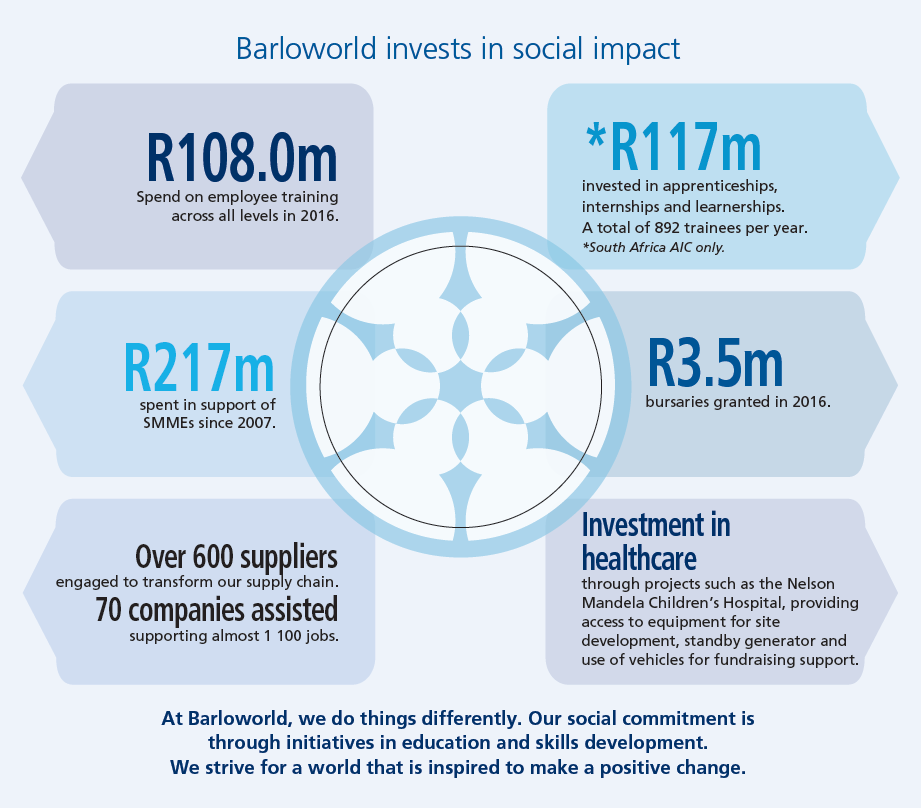
Barloworld’s commitment to positive social change is seen in our involvement in community development interventions that enhance education, health, economic inclusion, diversity and the environment. We have continuously invested in these areas through strategic partnerships with broader civil society, non-profit organisations (NPOs), our customers and government entities as we strive to inspire a positive change in the world.
| Value for our communities | SFAs addressing value for our communities | Material themes addressed by our SFAs | |
|
|
|
|
| Impact on the capitals | Enhancement and building of our social and relationship as well as human capital, affording us the licence to operate, do business in and draw skills from the communities where we operate | ||
| Impact on the communities |
Social and economic development of communities in which we operate | ||
| Engaging with our communities |
|
||
| Sources of value and benefits for communities | Benefits for Barloworld |
| Social cohesion and stability | Social relevance that gives licence to operate through good corporate citizenship |
| Addressing inequality through economic advancement, participation and inclusion | A stable environment in which to conduct sustainable business |
| Education initiatives that drive systemic improvements in educational outcomes contributing to the national skills pool | A diverse and inclusive workforce that contributes to innovation |
| Empowerment through various educational interventions | The ability to draw requisite skills from the communities in which we operate |
| Positive perceptions of both internal and external stakeholders |
Aligning to global and national development imperatives
Our efforts across the group to deliver social value are aligned to the Sustainable Development Goals at the global level as well as the national imperatives of the countries in which we operate, including South Africa’s National Development Plan 2030 framework.
Barloworld understands the benefits of an inclusive society in creating shared value that results in economic growth and sustainable livelihoods. The majority of our investments are through partnerships with likeminded organisations and stakeholders to make optimum use of finite resources and maximise delivery for the local communities in which we operate.
Partnering with the public sector and communities Barloworld has aligned our social development programmes with public sector initiatives, which include:
Jozi@Work
In collaboration with Avis Fleet, Barloworld Siyakhula has been assigned as a capability support agent with the City of Johannesburg’s Jozi@Work job creation initiative. As a project partner, Siyakhula provides small business training and diagnostic services, development support, mentoring and advisory services to the SME beneficiaries, in addition to project management support.
Sunflower Revitalisation Project
Sunflowers are benefiting smallholder farmers and the wider AmaHlubi community in South Africa’s North West province. In an agricultural partnership with the AmaHlubi, Barloworld has supplied tractors and equipment at discounted prices and warranties, trained 10 machine operators and drafted a mechanisation and service plan for the first 500 hectares of sunflower production. In addition to creating jobs and improving the overall wealth of the community, five primary schools, three high schools, five clinics and a tribal office have been built so far with income from the community’s sunflower fields.
The Barloworld Trust
The Barloworld Trust social investment approach continues to support development initiatives, with a particular focus on building capacity and partnering on innovative projects to improve education outcomes for local communities, especially young people. In South Africa, these CSI initiatives are aligned to B-BBEE socio-economic development (SED) imperatives.
The trust committed more than R149.5 million over the past 10 years. Some of the areas of investment include:
- Education
Barloworld is committed to continued investment in education – from early childhood and beyond – to help address the skills shortage in South Africa.
Our education investment encompasses support for early childhood development; improving teaching and learning outcomes, particularly in the core subjects of mathematics, science and language proficiency at primary and secondary levels; and facilitating access to tertiary education for underserved and/or marginalised communities.
Through our continued involvement with and support of Enactus, a global community that harnesses the social entrepreneurial skills of university students to drive community-based projects, Barloworld is able to positively impact and strengthen local communities and build leadership capacity for the students as they embark on their journey to the world of work or entrepreneurial ventures.
Barloworld also supports programmes to develop leadership skills for young people to nurture future leaders.
- Environment
Not only is Barloworld committed in minimising our own environmental impact, we also support the work of environmental organisations such as the Endangered Wildlife Trust (EWT) and the Worldwide Fund for Nature South Africa (WWF). The former champions the conservation of threatened wildlife species and habitats in southern Africa and the latter strives to create awareness of, and eliminate, the degradation of the earth’s natural environment.
- Employee Volunteer Programme
Barloworld encourages active citizenship and volunteerism by employees around the world, to make a difference in their communities and within their spheres of influence. On Mandela Day, our employees supported Stop Hunger Now, an organisation that provides nutritious meals to vulnerable children, by contributing to a meal packing initiative whose overall target was to provide three million meals to 56 000 beneficiaries across South Africa.

Twenty-three teams volunteer to fight hunger
Twenty-three Barloworld teams made up of 20 members each joined thousands of other Stop Hunger Now volunteers to successfully pack meals for needy beneficiaries in commemoration of Mandela Day. The target for the day was set at 800 000 meals, which was well surpassed.
For the second year running, Barloworld’s employees devoted their 67 minutes – and more this July, to pack meals as part of Stop Hunger Now’s “Stop Hunger on Mandela Day” project.
Barloworld regularly partners with global non-profit organisations such as Stop Hunger Now SA to make a difference to the plight of those living with chronic hunger as we strive to be responsive to the needs of the communities where we do business.
A human production line of 20 people per workstation was assembled to pack the meals, which contain rice, soya, a mix of dehydrated vegetables and a nutrient sachet, produced by Heinz, containing a hearty 23 vitamins and minerals.
At Barloworld we believe employee volunteering contributes to positive action, as well as to the teamwork and camaraderie that takes place when people have a common purpose and are proud to be a part of an initiative and partnership to highlight issues of food security and global hunger.

2017 outlook
In striving to be a good corporate citizen, Barloworld remains committed to creating shared value for stakeholders through inclusive opportunities that create pathways to sustainable livelihoods.
This is made possible by contributing to enhancing the quality of education and improving learner outcomes in early childhood development, primary and high school levels. Investing in programmes that provide access for young people to participate in the mainstream economy including focus on social entrepreneurship.
We will also focus on conducting an impact assessment on key projects as part of our quest to realise real outcomes from our CSI partnerships and interventions. The group is also working on a community engagement framework that will inform and guide both the group and divisional community outreach initiatives.
At Barloworld, we do things differently.
- Inspire innovation to drive our business.
- Grow smart ideas by incubating future business leaders.
- Help build on education and skills development by bringing innovation to life.
- Drive entrepreneurship that supports job creation and sustainability.
- Strive for a world that is inspired to change perspective.
- It is not just innovation we see but the difference we can make with it.
Perspective makes
a world of difference.
And so do we.

| For more information, please visit | ||
| http://www.barloworld.com/world-of-difference | |
@BarloworldLtd |